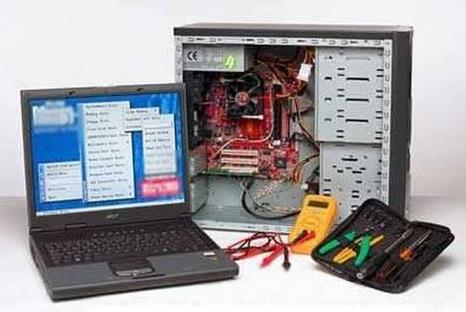
PC Buyer Beware! is a comprehensive PC guide covering desktop and laptop/notebook PCs that provides the knowledge required to make sensible buying, building, upgrading, networking, broadband, recovering, repairing and computer-security decisions, helping users to solve hardware and software problems - PC Problems & Solutions - via articles and questions and answers (Q&As) grouped in categories. The quickest way to find the solutions to a particular computer problem is to enter a short and accurate description of it, such as pc freezes or program freezes, both of them very common problems, in the Search pcbuyerbeware.co.uk feature provided at the top of each page. A list of pages containing those or your own keywords will be presented.
You can access the main sections of this website by making use of the navigation bar provided on the left side of each page, or specific information by entering a suitable search query in the site-search box.
All of the major components have their own section devoted to them, such as hard disk drives, graphics cards, processors, motherboards, monitors, networking equipment, etc. There are separate sections devoted to computer security, software and all of the versions of Windows currently in use - XP, Vista and Windows 7.
Essential information on using Windows 8 and upgrading to Win8 from Windows 7, Vista and XP -
http://www.pcbuyerbeware.co.uk/Essential-information-on-upgrading-to-windows-8.htm
Windows 8 problems: How to diagnose and fix problems with Win8 -
http://www.pcbuyerbeware.co.uk/Fix-Windows-8-Win8-Problems.htm
Windows 8 was made available worldwide on 26 October 2012. The run up to its release was several years long and the difference between Windows 7 and Windows 8, which can be used on a tablet or on a PC equipped with a touchscreen, is very marked, so there is no shortage of free and paid-for, in-depth, written guides and videos available on how to use it. For that reason, I will only be putting pages on this website that provide the news, essential how-to-use and upgrading information and deal with the methods of repair/recovery and problems with Windows 8. Here is an example that I came across recently:
Windows 8: It's Almost Not Terrible -
http://www.youtube.com/watch?v=X0fsyb-ttcw
I adapted to it and was able to find the information I needed fairly easily. It seems to me that if you can use previous versions of Windows you should be able to find your way around Win8 fairly easily and if you can't find something, the web has the information that covers every possible aspect. Unfortunately, people don't like marked changes in the way that anything works and, in my opinion, a negative attitude to Win8 proves this.
Click here! to read the latest computer-related news and general tips on this page.
The hardware and software problems dealt with on this website are in the order of their popularity. When applicable, the order will change to match the popularity recorded by this website's web logs in the previous month.
Click a relevant link below to visit the information it describes
2. - Software problems: How to fix problems with Windows, programs, and utilities
3. - Hard disk drive problems: How to fix computer hard disk drive (HDD) problems
4. - RAM memory problems: How to fix problems with the Random Access Memory
5. - Video/graphics card problems: How fix common computer video and graphics problems
6. - Network problems: How to fix common wired and wireless networking and internet problems
7. - Windows 8 problems: How to diagnose and fix problems with Windows 8
8. - Windows 7 problems: How to diagnose and fix problems with Windows 7
9. - Recover, restore and repair Windows 7 (Win7) when a computer crashes or fails to boot
10. - Windows Vista problems: How to fix common problems with Windows Vista
11. - Recovering and repairing Windows Vista when a computer crashes or fails to boot
12. - Windows XP: How to troubleshoot and fix shutdown, restart (reboot), and startup problems
13. - Recovering and repairing Windows XP when a computer crashes or fails to boot
14. - Laptop/notebook problems: How to address or fix the most common laptop/netbook problems
15. - Processor problems: How fix common processor (CPU) problems
16. - CD/DVD drive problems: How to fix problems with CD and DVD drives and discs
17. - USB and FireWire problems: - How to fix common USB and FireWire problems
18. - Typical DLL (Dynamic Link Library) device driver problems
Visit the Build Your Own PC pages of this website for information on how to build a desktop PC and solve self-build problems and visit the other sections, such as the Processors pages - which provides information on the brand-leading Intel Core family of processors - and the Video/Graphics, Sound, Motherboards and Monitors pages for more problem-solving information, all of which can be accessed via the menu items and jump menu on the orange navigation bar, or via the site search engine at the top of each of the main pages. When you know how to build a PC, you'll also know how to go about diagnosing problems and fixing one.
May 20, 2013. - The free version of the Malwarebytes anti-malware scanner can be used as an additional scanner that is run manually to augment the single malware scanner that you should have monitoring the system in real time. It's fine to use any number of scanners in this way just as long as only one of them is a real-time, ever-active scanner. There is also a Pro paid-for version of Malwarebytes that provides more features and support.
The Malwarebytes website also provides some useful free software.
Chameleon gets Malwarebytes running if it has been blocked by malware; Anti-Rootkit detects and removes concealed malware that installs itself under Windows (read the Readme file for instructions on how to use it by extracting the files from the zip file into a folder and then running the mbar.exe file); StartupLight disables unnecessary startup programs, making the boot-up faster; FileASSASSIN can delete files that have been blocked from being deleted; RegASSASSIN removes entries in the Windows Registry that have been placed in it by malware. Get them here:
http://www.malwarebytes.org/products/other_tools/
May 15, 2013. - Problem: I replaced a failed, unpartitioned SATA hard disk drive (100GB) on my laptop PC with an unpartitioned SSD drive with a larger capacity (128GB). Unfortunately, I couldn't restore the system image I saved to an external hard disk drive to it. When I installed just Windows 7 on the SSD drive and created a system image of it using Norton Ghost 3, which I have used for a decade, and also used Norton 15, which is the latest version. It also couldn't be restored to the SSD drive after I wiped it. Strangely, Symantec's support (the company that owns Norton Ghost) said that as SSD and hard drives use different techlology, so it's not possible to restore a system image on an internal or external hard drive back to an SSD.
Visit the following page on this website for the answer:
http://www.pcbuyerbeware.co.uk/HDDProblems.htm#failedssdrestore
May 12, 2013. - The Internet works using IP addresses, such as 195.238.172.129, which is the IP address of the domain name pcbuyerbeware.co.uk. The domain name is not used, so when you use a web browser (Internet Explorer, Firefox, Opera, etc.) to go to a domain name, a DNS (Domain Name System) server has to translate it into its IP address before te browser can connect to that website. The DNS server that is used will be supplied by the web user's Internet Service Provider. Some DNS servers are more secure than others. The OpenDNS DNS servers are monitored and kept as secure as possible. Therefore changing to using them instead of the probably significantly less secure DNS servers that your connection is using adds an extra layer of security.
Go to the following Q&A page on the PC Buyer Beware! website to find out how to do that:
http://www.pcbuyerbeware.co.uk/NetworkingProblems.htm#opendns
May 4, 2013. - I have the Adobe Flash Player, which plays videos on many sites such as YouTube, set in its control panel in the Windows Control Panel to tell me when an update is available. I have just had a pop-up asking me if I want the latest update installed. I gave my permission to install it. The option that was included to install Google Chrome as my default web browser automatically is shown in the image below.
It is enabled by default, so unless you remove the check mark, Google Chrome is installed with the Flash Player update and will be the browser that is used every time you click on a link in an email, etc. During its installation, Chrome adds many entries in the Windows Registry that remain there even if you uninstall it. I was caught out the first time this happened and had to spent about half an hour searching the Registry for references to Chrome and removing them. If you want to search the Registry, use the search query search the windows registry plus your version of Windows. An easier method is to restore a System Restore restore point that predates the installation.
Given Google's addiction to obtaining private information in order to be able to identify web users and serve them with customised ads, if you value your privacy, having Chrome installed, even if you don't use it, is not advisable. Google is obviously paying Adobe to include this very sneaky way of installing Chrome because the Flash Player is installed on 99% of desktop and laptop PCs and it is updated regularly.
I have also seen a similar option to install McAfee Security Scan Plus, the check mark for which I also remove before the Flash Player installation because I don't like McAfee software. It has a tendency to screw things up.
May 1, 2013. - The Previous Versions feature provided by Windows Vista and Windows 7 has been replaced by a the feature called File History in Windows 8. The end of making it possible to restore previous versions of files and folders remains, but the improved means to do so are different.
Previous versions of files: frequently asked questions -
Windows Vista - http://windows.microsoft.com/en-us/windows-vista/...
Windows 7 - http://windows.microsoft.com/en-US/windows7/...
In Vista and Win7 the restoration is achieved by right-clicking on any folder followed by clicking on "Restore previous versions" in the menu that comes up.
File History in Win8 has to be set up first according to the following Microsoft support article.
Set up a drive for File History -
http://windows.microsoft.com/en-us/windows-8/set-drive-file-history
How to use File History -
http://windows.microsoft.com/en-us/windows-8/how-use-file-history
The design of the File Recovery menu is much better than the Restore Previous Versions feature in Windows Vista/7. The following article documents how useful it can be.
How Windows 8 File History saved my career -
http://www.pcpro.co.uk/blogs/2012/08/03/how-windows-8-file-history-saved-my-career/
April 27, 2013. - In previous versions of Windows, booting into Safe Mode required pressing the F8 key repeatedly at startup just before Windows starts to load. To get into Safe Mode in Windows 8 requires holding the Shift key down at startup while pressing the F8 key repeatedly just before Windows starts to load to bring up the new graphical user interface that works with the mouse or taps on a touchscreen - if the desktop PC, laptop or tablet computer has one. If Windows 8 is left alone it boots all the way to the password-entry screen - if a password has been set.
In a dual-boot system, such as one that can boot into Windows XP or Windows 8, that user interface presents itself automatically, because it has to give the user a choice of the operating system with which to boot the system.
Unfortunately, Safe Mode is buried deeply in the options that are presented. The following article on this website tells you how to navigate to the option that allows the system to boot into Safe Mode (or to activate the Refresh or Reset system-recovery options).
http://www.pcbuyerbeware.co.uk/Boot-into-Safe-Mode-in-Windows-8-Win8.htm
April 20, 2013. - Microsoft provides five very useful free security tools to users of Windows XP, Vista and Windows 7 & 8, only two of which are well known. Here are the details from the most to the least powerful:
1. - Security Essentials provides free all-in-one security protection from malicious software (viruses, Trojans that open up your system to hackers, fake security software, keyloggers, etc.) and software of the kind that no one wants. It has to be downloaded and installed after which it monitors the system in real time (downloads, web access, loading programs, opening files, etc.) so no other real-time security scanner should be used with it, and it is available only for Windows XP, Vista and Windows 7. Windows 8 has Windows Defender, which is almost exactly like Security Essentials except that it is installed with Win8 and controlled by it via the Security Center, like the Windows Firewall. It will be dealt with next. I use Security Essentials on my XP and Win7 computers (it cannot be used in Windows 8, so uninstall it before upgrading from an earlier version of Windows) and I have never suffered from a moderate or a catastrophic infection that laid the system to waste. If you leave it at its default settings, it works perfectly well and can be left alone to inform you if it needs updating the system needs to be scanned. Its icon in the Notification Area changes from green to orange to red, depending on the urgency of the action(s) requires. It is also customisable to a high degree, which Windows Defender is not. Scans can be scheduled and there are plenty of customisable settings that are easy to understand.
The free version of Malwarebytes, which cannot be used in real-time mode unless it is the paid-for version, is my first choice for a secondary non-real-time scanner.
Security Essentials - http://www.microsoft.com/security/pc-security/mse.aspx
2. - Windows Defender is an all-in-one malware scanner that looks almost exactly like Security Essentials. Windows Defender is installed by default in Vista and Windows 7, but it is only a spyware scanner, so it is best to disable it and download and install Security Essentials or a comprehensive third-party scanner. Only the version that is built into Windows 8, running in it by default, is an all-in-one malware scanner, so it has to be disabled if you install Security Essentials or any other real-time monitoring scanner. It is available as a download for Windows XP, but will probably cease to be when security support for XP ends in April 2014 and why bother using it when Security Essentials is available for XP.
Microsoft's first malware scanner was called Microsoft AntiSpyware and then renamed Windows Defender. It was only an anti-spyware scanner that developed into Security Essentials, which, being an all-in-one scanner, provides protection against all malware. Now Microsoft has called the scanner built into Windows 8 Windows Defender. It is almost exactly like Security Essentials, allowing Quick, Full and Custom scans, but it is much less customisable. Scans cannot be scheduled from within it, nor by using the Task Manager, which can be chosen from the menu that comes up when pressing the Ctrl+Alt+Del key combination on both the Start and Desktop screens in Win8. It is also not possible to right-click on a file or folder to run a scan. If you prefer having a more versatile malware scanner, such as the free or paid-for versions of AVG AntiVirus, you can turn off Windows Defender under its Settings tab. Click on Administrator and remove the check mark beside Turn on Windows Defender. You can then install your preferred scanner. Remember, you should not have two malware scanners operating in real-time monitoring of the system.
3 and 4. - Microsoft provides two very useful clean-up tools that perform a clean up after an infection. The two tools can also be used to verify that the system being scanned by them is free of malware.
Microsoft Safety Scanner is a 77MB download that can be used on 32-bit and 64-bit versions of Windows XP, Vista, Win7 and Win8. A stand-alone tool, it has to be run manually every time, so it won't interfere with your real-time malware scanner. Very easy to use, it performs a thorough system scan, removing malware and cleaning the system of anything that the removed malware might have downloaded and installed. Click the following link to download it.
http://www.microsoft.com/security/scanner/en-us/default.aspx
Since Windows Defender Offline (WDO) is the most powerful security tool, it should have been at the top of the list, but it fits in nicely here. Looking and functioning much like Security Essentials and the version of Windows Defender that is built into Windows 8, it is another self-contained utility designed to work outside Windows, allowing it to conduct deep scans from system startup that can detect hidden malware while Windows itself is inactive. When you download and run it, its setup takes you through the process of creating a bootable CD/DVD or flash drive that is used to boot the system. Remember that the computer's BIOS setup program must have the boot media's device set as the first boot device for it to be bootable. If you are using a DVD disc, the DVD drive must be set as the first boot device in the order of boot devices. If it is run from a CD/DVD or from a flash drive, it goes online to update itself with the latest malware signatures that it uses to identify an infection, so you should use the latest version. If there is a new version, create a new boot disc or flash drive. Its main weakness, apart from not being able to detect viruses that have not been detected before, a weakness that all virus scanners have, is that you have to have the boot media ready when disaster strikes. If you only have one computer it's advisable to create a new bootable disc or flash drive say once a month. If you have access to another computer, you can use it to create the bootable media at any time as long as you can get online. You can download it for your version of Windows from the following webpage:
What is Windows Defender Offline? -
http://windows.microsoft.com/is-is/windows/what-is-windows-defender-offline
5. - The Malicious Software Removal Tool (MSRT) is the most basic of Microsoft's free tools, currently targeting about 200 of the most common malware types that are listed on its download page. Yes, its latest version is installed and run once a month, but it is also available as a download. It is activated automatically when Windows XP, Vista and Win 7 & 8 are installed. It is then updated like Windows itself every month on Patch Tuesday - any month's second Tuesday.
The scanner can be run manually at any time by entering mrt.exe in XP's Start => Run box or from the Vista/Win7 Start menu's Search... box. In Windows 8, just type mrt while on the Start screen to be provided with a link to it on the left-hand side of the new screen that is presented. The scan options are the same as Security Essentials and Windows Defender - Quick, Full and Custom scans. A full scan is the most thorough and takes the longest - up to several hours. I would prefer to use Windows Defender Offline for a thorough once-a month scan, because it is the most powerful of all of Microsoft's scanners.
Malware Families Cleaned by the Malicious Software Removal Tool -
http://www.microsoft.com/security/pc-security/malware-families.aspx
April 13, 2013. - The new SSD drives that are slowly replacing standard hard disk drives (slowly due to their much higher cost per gigabyte) use types of flash memory instead of the revolving magnetic platters that are used by traditional hard disk drives that are searched by heads similar to the stylus used by a gramophone.
The memory used by an SSD has a limited lifespan so constantly writing to the same storage area more than to other areas, kills them ahead of the other less-used areas and renders the drive unusable. Therefore, Windows can't be allowed to use an SSD drive in the same way in which it uses a hard disk drive. Windows 7 & 8 support SSDs, but some configuration might be necessary to force windows not to write to the same areas of the drive constantly.
Here is an article on this website that provides information on this problem:
How to set up an SSD drive in Windows 7 & 8 optimally to increase its limited lifespan -
http://www.pcbuyerbeware.co.uk/Set-up-an-SSD-drive-optimally-to-increase-limited-lifespan.htmApril 10, 2013. - The following free tool improves Windows Explorer in Windows 7.
xplorer2 Free Lite -
Only available as a 32-bit version, but it works just fine in 64-bit Windows 7. It can be used instead of File Explorer, the new name for Windows Explorer in Windows 8. The Professional version costs $30. You can try it for a limited time before making a purchase. Note that the free version installs software that you probably don't want unless you disable its installation.
Better Explorer - Provides both a Ribbon user interface and tabs for multiple folders -
Autoruns for Windows v11.5 -
The supreme startup monitor that stands on the shoulders of the standard Windows msconfig utility.
http://technet.microsoft.com/en-us/sysinternals/bb963902.aspx
If you want better copy controls than the mediocre ones offered by Windows 7, here is a good tool, which is free for personal use:
TeraCopy - http://codesector.com/teracopy
This useful free tool skips bad files and you can pause copying and it doesn't keep interrupting transfers with messages, as Windows does, asking for permission to continue. The Pro version with more features costs $20.
AnVir Task Manager Free - replaces the Task Manager in Windows 7 and adds many of the features of the magnificent Task Manager provided by Windows 8. The Pro version with additional features costs $49.95. - http://www.anvir.com/
Now that Microsoft has advised that all Gadgets be disabled due to security vulnerabilities (Windows 8 doesn't provide them for that reason), you shouldn't be using the processor (CPU) and RAM memory meters that can be installed by right-clicking an empty space on the Desktop and then clicking Gadgets. MemInfo is excellent free alternative memory meter. Find out how it can inform you of malware infections that affect the use of memory by reading the introduction on the following page of this website:
http://www.pcbuyerbeware.co.uk/PC-Problems-Solutions.htm
April 8, 2013. - When I open or preview some emails in Outlook, I can see that the system is trying to contact ox-social.bidsystem, after which I have to restart Outlook. Is this as serious as it looks?
Click on the following link to read the answer on this website.
http://www.pcbuyerbeware.co.uk/NetworkingProblems.htm#oxsocialbidsystem
Click here! to go to the page on this site that deals with Windows 7, Microsoft's replacement for Windows Vista.
Click here! to go to the page on this site that deals with Windows Vista, Microsoft's replacement for Windows XP.
For PC security information visit the main Security section of this website, or make use of the site search engine at the top of each of the main pages to search for references to specific information on topics such as how best to keep secure on the web, security software, hardware and software firewalls, identity theft, privacy issues, how to hide form Google, phishing scams, viruses, malware, spyware, how to implement spyware removal and the different types of backups, etc.
While every effort has been taken to ensure the accuracy of the information contained on this website, the author assumes no responsibility for errors or omissions, or for damages resulting from the use of the information contained herein.
Click here! to email me concerning this website.
Click here! to tell a friend about the PC Buyer Beware! website.
If you think that PC Buyer Beware! - http://www.pcbuyerbeware.co.uk/
- is a good website that the visitors to your website or blog
would find informative, you can place a linked
banner to it by using one of the animated GIF files,
below. 